publications
publications by categories in reversed chronological order.
2026
- ECCV
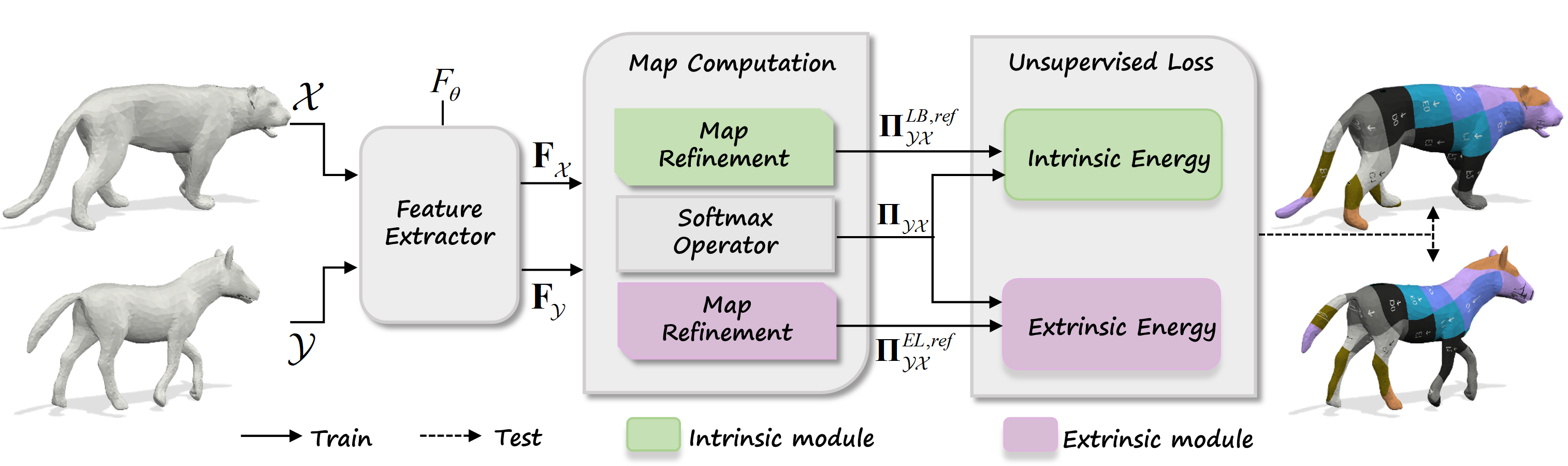 Coarse-to-Fine: A Hybrid Self-Supervised Method for Non-rigid 3D Shape MatchingFeifan Luo, Ting Li, Zhao Li, and 1 more authorIn Proceedings of European Conference on Computer Vision, 2026
Non-rigid 3D shape matching is a fundamental task in computer vision and graphics. In this paper, we propose a hybrid self-supervised method based on a coarse-to-fine strategy, which ensures consistency between the coarse mapping and the refined correspondence produced by our refinement module. The architecture features a dual-branch design, consisting of two symmetric functional map learning streams: one based on the Laplacian basis and the other utilizing the elastic basis. Extensive experiments show that our approach not only maintains computational efficiency, but also achieves state-of-the-art performance across a variety of challenging scenarios, including non-isometric deformations and topological noise. Finally, we rigorously demonstrate that contrastive energies promote feature discrimination. Furthermore, integrating these energies with existing methods yields consistent improvements, validating the overall efficacy of our approach.
@inproceedings{luo2026coarse, title = {Coarse-to-Fine: A Hybrid Self-Supervised Method for Non-rigid 3D Shape Matching}, author = {Luo, Feifan and Li, Ting and Li, Zhao and Chen, Hongyang}, booktitle = {Proceedings of European Conference on Computer Vision}, year = {2026}, } - CVPR
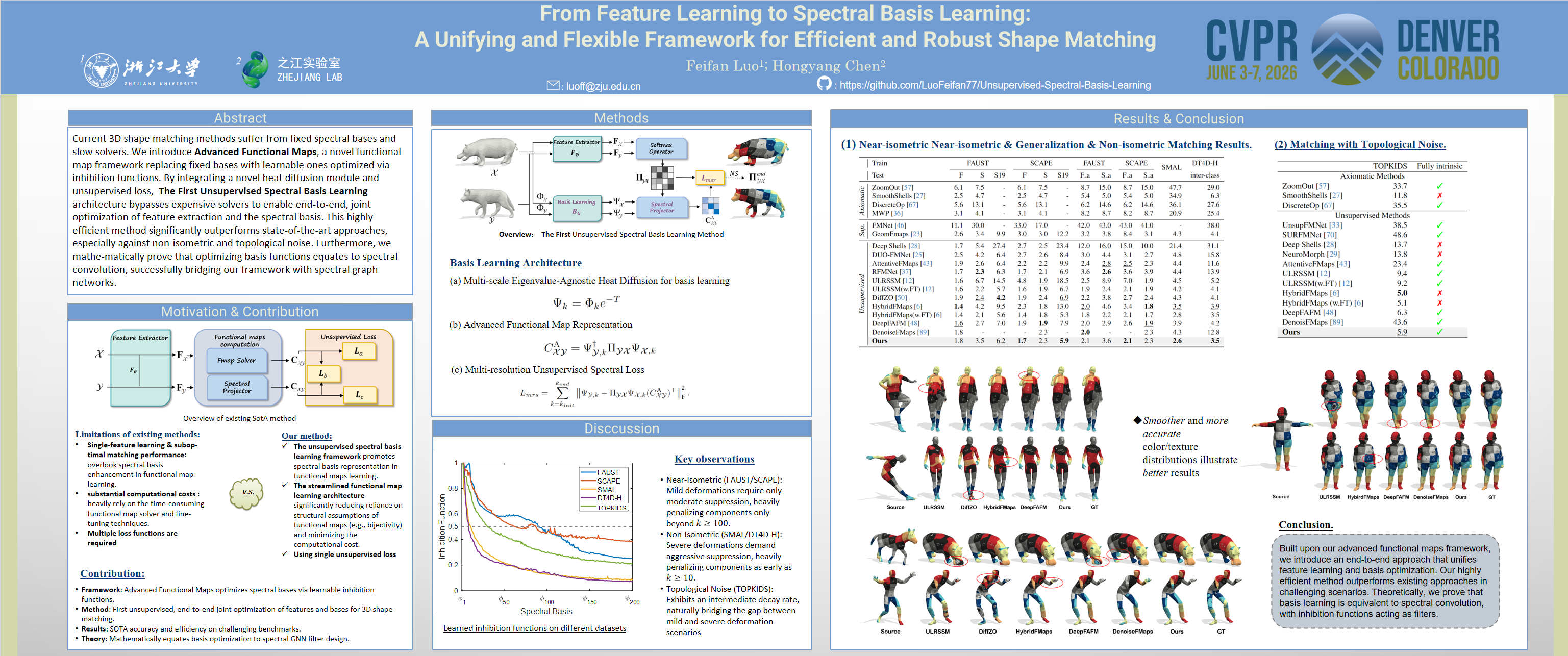 From Feature Learning to Spectral Basis Learning: A Unifying and Flexible Framework for Efficient and Robust Shape MatchingFeifan Luo and Hongyang ChenIn Proceedings of the IEEE/CVF Conference on Computer Vision and Pattern Recognition, 2026
Shape matching is a fundamental task in computer graphics and vision, with deep functional maps becoming a prominent paradigm. However, existing methods primarily focus on learning informative feature representations by constraining pointwise and functional maps, while neglecting the optimization of the spectral basis—a critical component of the functional map pipeline. This oversight often leads to suboptimal matching results. Furthermore, many current approaches rely on conventional, time-consuming functional map solvers, incurring significant computational overhead. To bridge these gaps, we introduce Advanced Functional Maps, a framework that generalizes standard functional maps by replacing fixed basis functions with learnable ones, supported by rigorous theoretical guarantees. Specifically, the spectral basis is optimized through a set of learned inhibition functions. Building on this, we propose the first unsupervised spectral basis learning method for robust non-rigid 3D shape matching, enabling the joint, end-to-end optimization of feature extraction and basis functions. Our approach incorporates a novel heat diffusion module and an unsupervised loss function, alongside a streamlined architecture that bypasses expensive solvers and auxiliary losses. Extensive experiments demonstrate that our method significantly outperforms state-of-the-art feature-learning approaches, particularly in challenging non-isometric and topological noise scenarios, while maintaining high efficiency. Finally, we reveal that optimizing basis functions is equivalent to spectral convolution, where inhibition functions act as filters. This insight enables enhanced representations inspired by spectral graph networks, opening new avenues for future research.
@inproceedings{luo2026feature, title = {From Feature Learning to Spectral Basis Learning: A Unifying and Flexible Framework for Efficient and Robust Shape Matching}, author = {Luo, Feifan and Chen, Hongyang}, booktitle = {Proceedings of the IEEE/CVF Conference on Computer Vision and Pattern Recognition}, year = {2026}, } - AAAI
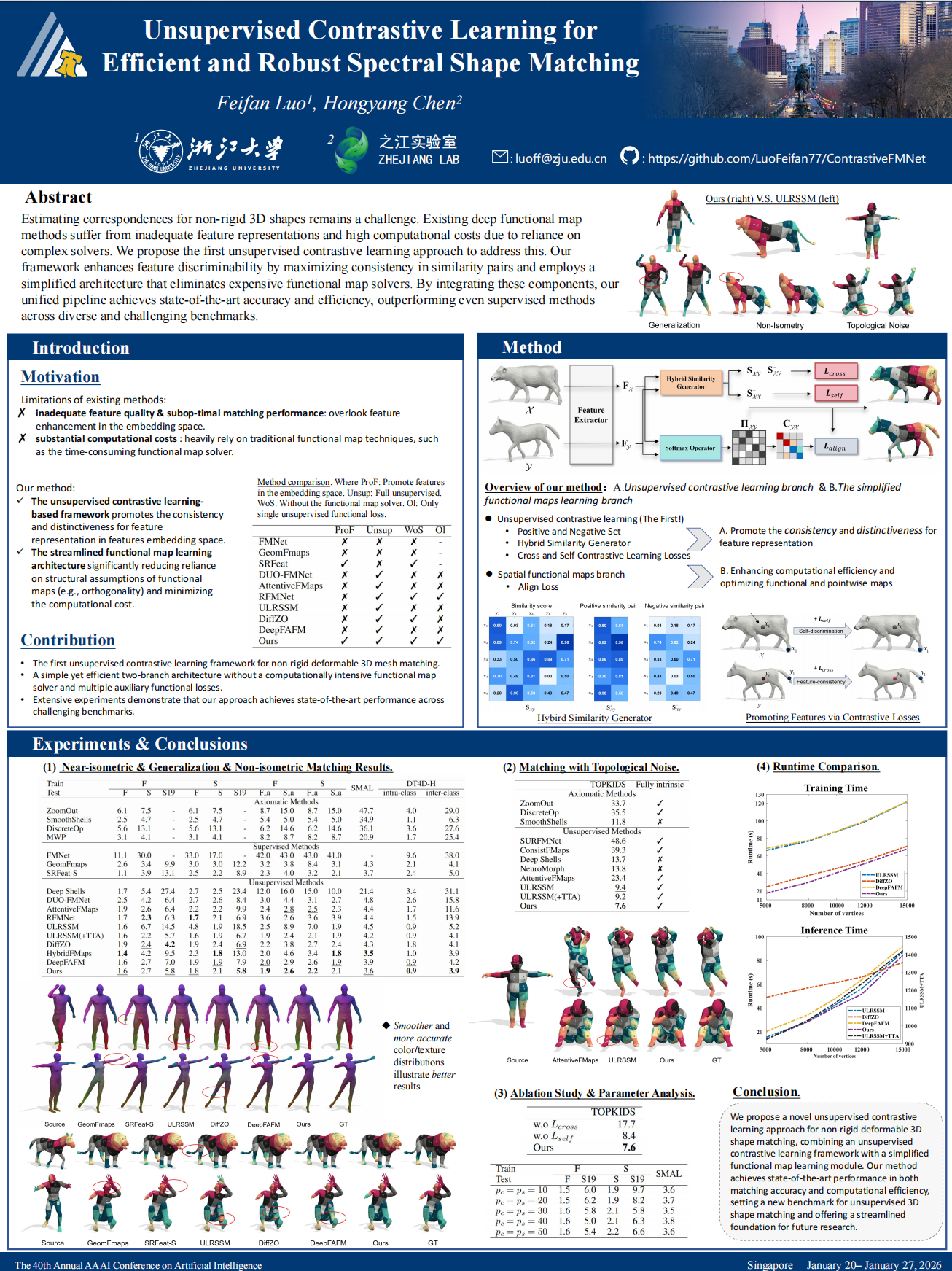 Unsupervised Contrastive Learning for Efficient and Robust Spectral Shape MatchingFeifan Luo and Hongyang ChenIn Proceedings of the AAAI Conference on Artificial Intelligence, 2026
Estimating correspondences between pairs of non-rigid deformable 3D shapes remains a significant challenge in computer vision and graphics. While deep functional map methods have become the go-to solution for addressing this problem, they primarily focus on optimizing pointwise and functional maps either individually or jointly, rather than directly enhancing feature representations in the embedding space, which often results in inadequate feature quality and suboptimal matching performance. Furthermore, these approaches heavily rely on traditional functional map techniques, such as time-consuming functional map solvers, which incur substantial computational costs. In this work, we introduce, for the first time, a novel unsupervised contrastive learning-based approach for efficient and robust 3D shape matching. We begin by presenting an unsupervised contrastive learning framework that promotes feature learning by maximizing consistency within positive similarity pairs and minimizing it within negative similarity pairs, thereby improving both the consistency and discriminability of the learned features. We then design a significantly simplified functional map learning architecture that eliminates the need for computationally expensive functional map solvers and multiple auxiliary functional map losses, greatly enhancing computational efficiency. By integrating these two components into a unified two-branch pipeline, our method achieves state-of-the-art performance in both accuracy and efficiency. Extensive experiments demonstrate that our approach is not only computationally efficient but also outperforms current state-of-the-art methods across various challenging benchmarks, including near-isometric, non-isometric, and topologically inconsistent scenarios—even surpassing supervised techniques.
@inproceedings{luo2026unsupervised,
  title = {Unsupervised Contrastive Learning for Efficient and Robust Spectral Shape Matching},
  author = {Luo, Feifan and Chen, Hongyang},
  booktitle = {Proceedings of the AAAI Conference on Artificial Intelligence},
  volume = {40},
  number = {9},
  pages = {7662--7670},
  year = {2026},
}
2025
- TVCG
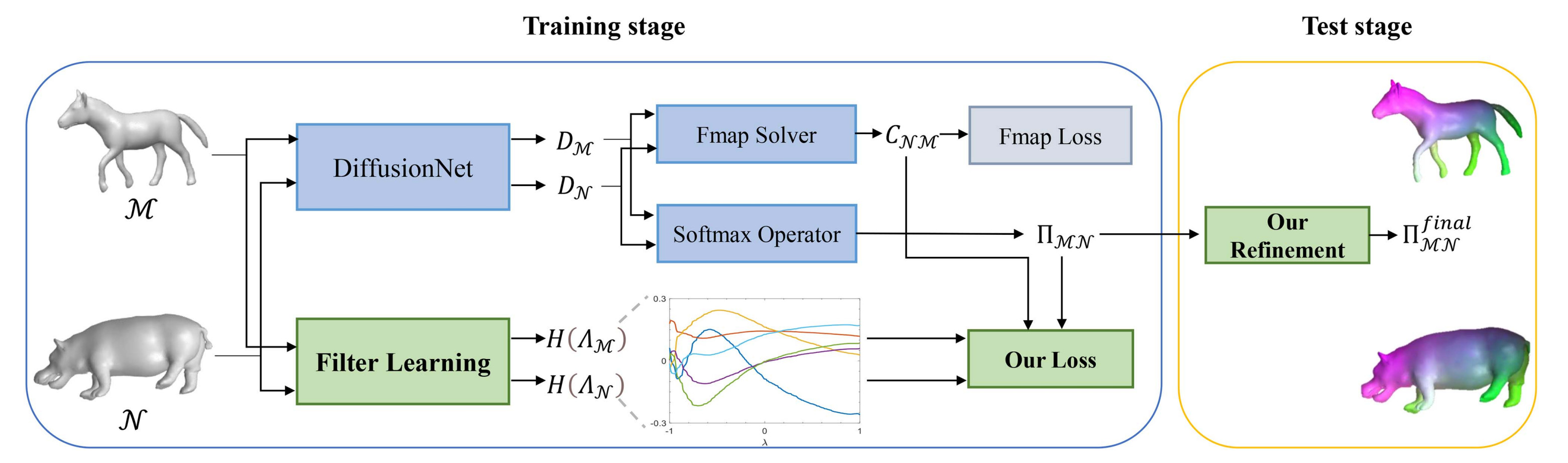 Deep Frequency Awareness Functional Maps for Robust Shape MatchingFeifan Luo*, Qinsong Li*, Ling Hu, and 5 more authorsIEEE Transactions on Visualization and Computer Graphics, 2025
Traditional deep functional map frameworks are widely used for 3D shape matching; however, many methods fail to adaptively capture the relevant frequency information required for functional map estimation in complex scenarios, leading to poor performance, especially under significant deformations. To address these challenges, we propose a novel unsupervised learningbased framework, Deep Frequency Awareness Functional Maps (DFAFM), specifically designed to tackle diverse shape-matching problems. Our approach introduces the Spectral Filter Operator Preservation constraint, which ensures the preservation of critical frequency information. These constraints promote frequency awareness by learning a set of spectral filters and incorporating them as a loss function to jointly supervise the functional maps, pointwise maps, and spectral filters. The spectral filters are constructed using orthonormal Jacobi polynomials with learnable coefficients, enabling adaptive and efficient frequency representation. Furthermore, we propose a refinement strategy that leverages the learned spectral filters and constraints to enhance the accuracy of the final pointwise map. Extensive experiments conducted on multiple benchmark datasets demonstrate that our method outperforms state-of-the-art approaches, particularly in challenging scenarios involving non-isometric deformations and inconsistent topology.
@article{luo2025deep,
  title = {Deep Frequency Awareness Functional Maps for Robust Shape Matching},
  author = {Luo, Feifan and Li, Qinsong and Hu, Ling and Wang, Haibo and Xu, Haojun and Liu, Xinru and Liu<sup></sup>, Shengjun and Chen<sup></sup>, Hongyang},
  journal = {IEEE Transactions on Visualization and Computer Graphics},
  year = {2025},
  publisher = {IEEE},
}
2024
- TVC
 Deformable shape matching with multiple complex spectral filter operator preservationQinsong Li, Yueyu Guo, Xinru Liu, and 3 more authorsThe Visual Computer, 2024
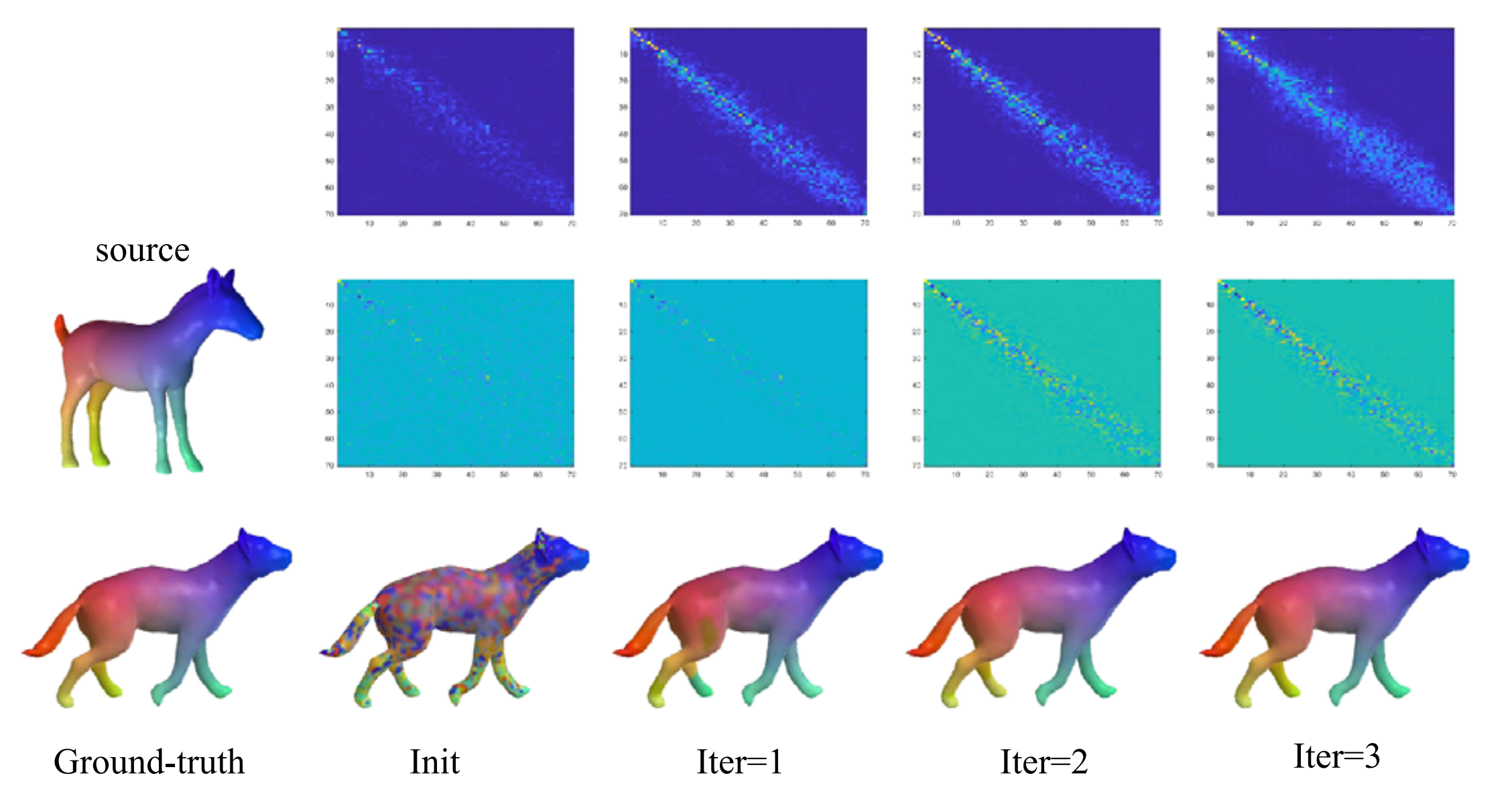
The functional maps framework has achieved remarkable success in non-rigid shape matching. However, the traditional functional map representations do not explicitly encode surface orientation, which can easily lead to orientation-reversing correspondence. The complex functional map addresses this issue by linking oriented tangent bundles to favor orientation-preserving correspondence. Nevertheless, the absence of effective restrictions on the complex functional maps hinders them from obtaining high-quality correspondences. To this end, we introduce novel and powerful constraints to determine complex functional maps by incorporating multiple complex spectral filter operator preservation constraints with a rigorous theoretical guarantee. Such constraints encode the surface orientation information and enforce the isometric property of the map. Based on these constraints, we propose a novel and efficient method to obtain orientation-preserving and accurate correspondences across shapes by alternatively updating the functional maps, complex functional maps, and pointwise maps. Extensive experiments demonstrate our significant improvements in correspondence quality and computing efficiency. In addition, our constraints can be easily adapted to other functional maps-based methods to enhance their performance.
@article{li2024deformable, title = {Deformable shape matching with multiple complex spectral filter operator preservation}, author = {Li, Qinsong and Guo, Yueyu and Liu, Xinru and Hu, Ling and Luo<sup></sup>, Feifan and Liu<sup></sup>, Shengjun}, journal = {The Visual Computer}, volume = {40}, number = {7}, pages = {4885--4898}, year = {2024}, publisher = {Springer}, } - TVC
 AWEDD: a descriptor simultaneously encoding multiscale extrinsic and intrinsic shape featuresShengjun Liu, Feifan Luo, Qinsong Li, and 2 more authorsThe Visual Computer, 2024
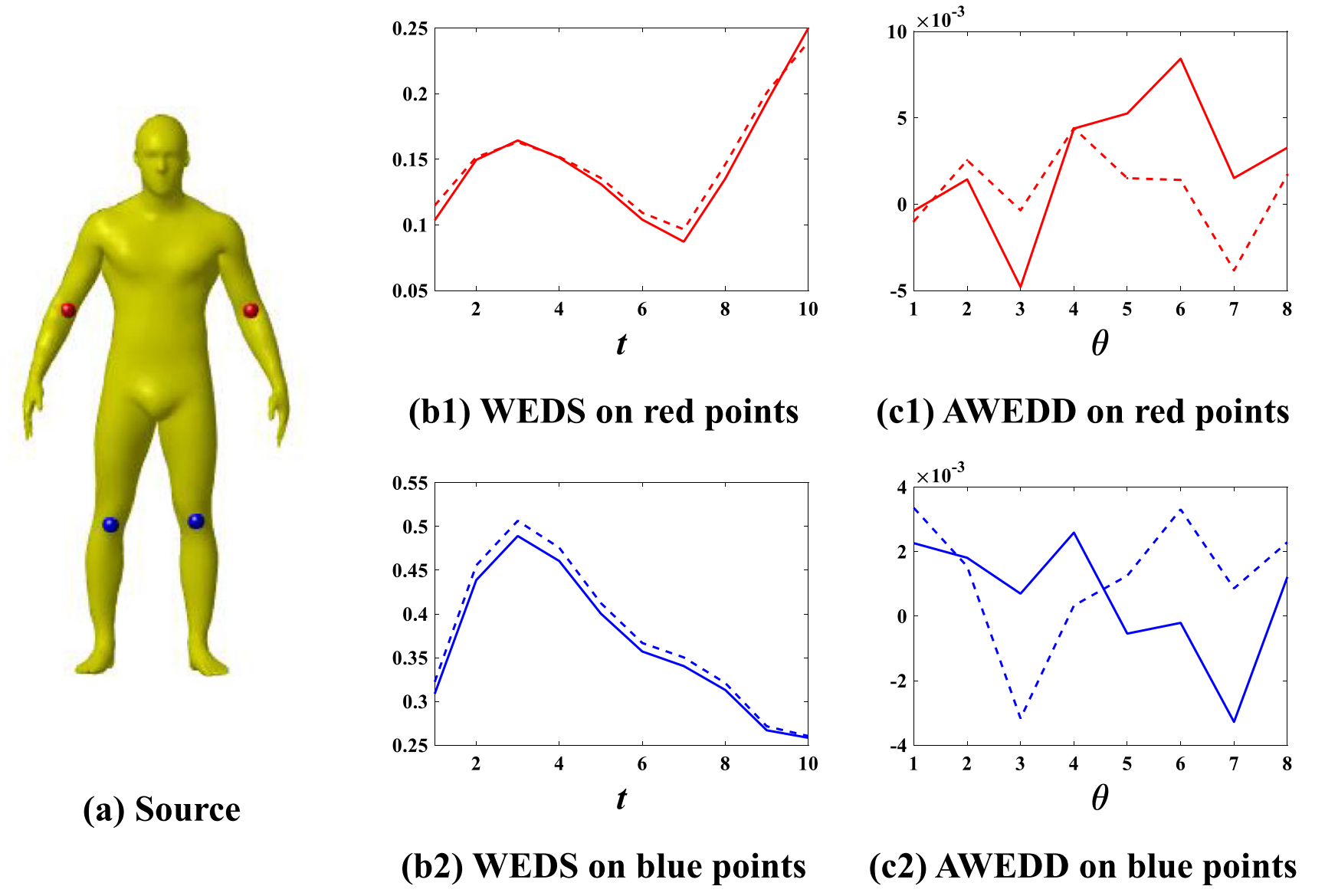
We construct a novel descriptor called anisotropic wavelet energy decomposition descriptor (AWEDD) for non-rigid shape analysis, based on anisotropic diffusion geometry. We first extend the Dirichlet energy of the vertex coordinate function to an anisotropic version, then use multiscale anisotropic spectral manifold wavelets to decompose the Dirichlet energy to all vertices and collect local energy at each vertex to form AWEDD. AWEDD simultaneously encodes multiscale extrinsic and intrinsic shape features, which are more informative and robust than purely intrinsic or extrinsic descriptors. And the introduction of anisotropy endows AWEDD with stronger abilities of feature discrimination and intrinsic symmetry identification. Our results demonstrate that AWEDD is more discriminative than current state-of-the-art descriptors. In addition, we show that AWEDD is an excellent choice of the initial inputs for various shape analysis approaches, such as functional map pipelines and deep convolutional architectures.
@article{liu2024awedd,
  title = {AWEDD: a descriptor simultaneously encoding multiscale extrinsic and intrinsic shape features},
  author = {Liu, Shengjun and Luo, Feifan and Li, Qinsong and Liu, Xinru and Hu, Ling},
  journal = {The Visual Computer},
  volume = {40},
  number = {4},
  pages = {2537--2554},
  year = {2024},
  publisher = {Springer},
}